Universal Algorithm-Implicit Learning accepted at ICML 2026
We are very excited to share that our paper Universal Algorithm-Implicit Learning has been accepted at ICML 2026.
The promise. Meta-learning aims to create algorithms that do not learn a specific task, but rather “learn to learn” new tasks with minimal supervision. Practically, this means we could have a base network that adapts to any task with just a few training examples.
The reality. Current meta-learning algorithms are not flexible enough to actually be used this way. Most are trained with fixed constraints, such as a fixed number of output classes, and evaluated only on toy benchmarks.
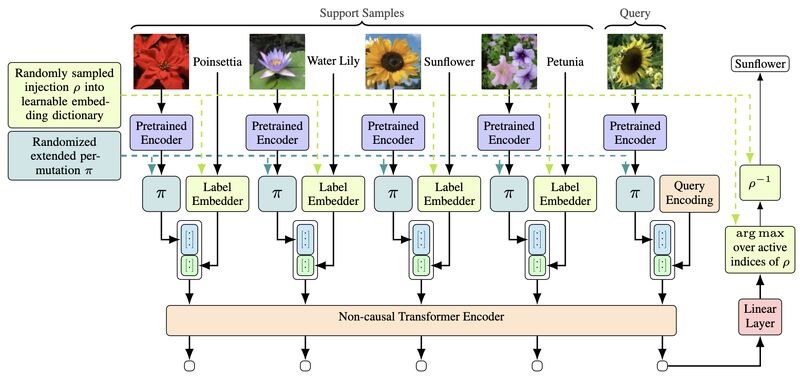
The fix. In this paper we propose TAIL, a new meta-learner that generalises across a wide range of image classification tasks and even works on text classification out of the box, without ever having been trained on text. Our method treats prediction as a sequence completion task and uses a transformer trained on a large meta-dataset of image classification tasks to solve it.
TAIL is
- robust: achieves state-of-the-art classification on various benchmarks,
- cross-modal: trained on images, it generalises to text,
- flexible: handles arbitrary label spaces and up to 20× more classes than seen during training,
- fast: predicts orders of magnitude faster than other transformer-based meta-learners.
This is Stefano Woerner’s final paper of his PhD, finishing a strong PhD with a highlight. Huge congratulations to Stefano, and many thanks to Seong Joon Oh for the great collaboration.
Paper: https://arxiv.org/abs/2602.14761
Code: https://github.com/StefanoWoerner/TAIL